Mankell Family History
Johan Herman Mankel's Controversies
Professionally and personally Johan Herman Mankel led a colorful and controversial life in Christiansfeld. By 1805 Mankel was very busy with his music: composing instrumental and choral music, teaching music to the Moravian community, and leading worship as organist for the congregation. And he gained great respect when he composed a march for the Swedish royal family’s visit to the congregation. King Gustav IV was so pleased that he asked for a copy of the music, and gave Johan a gold watch as payment
JHM's Music
By 1811 an issue grew in the congregation regarding the proper role of music and Johan appears to have been in the middle of it. Was the music becoming too secular, and thus were Moravian musicians losing their purpose of being centered in Christ?
Music has always played a prominent role in the Moravian church and in the spiritual life of its members. This distinct understanding of music was divided into 3 categories: in the congregation, in the Moravian Church, and in the secular community. The Moravian community believed music of the members was most important, because it led to an experience of feeling centered in Christ. Playing a musical instrument served the cause of the Lord no less directly than ministering the Gospel to the Brethren. Documents state that during Mankel’s years as music leader, the congregation had a Trombone Choir, a Wind Band, and a Church Choir (and possibly more). The latter two exist today. And the music and musicians in this community increased in musical ability because of Mankel. However, Moravian musicians were subject to the church’s customs and stricter roles in life and Johan appears to have taken an attitude different from the Elders. Johan and some of the musicians became dissatisfied with how the congregation looked upon the music they presented.
The congregation’s musicians had a tradition of playing for festive occasions outside of the Brethren Hall or Parish Hall, including choral festivals where the music was extraordinarily rich. But it appears that the music was becoming more important than the liturgical atmosphere. According to some in the congregation the Brethren’s musicians made a greater effort to serve the music, rather than the parish. A compromise, of sorts, was reached. Musicians balanced their playing in town events with their responsibilities to the church. And by 1814 the musicians provided music for a festive ball honoring a military general who came to Christiansfeld. Mankel, a composer and organist, lived in the time of Mozart, Handel, Haydn and Beethoven. Given this musical atmosphere, it’s not surprising that a worldliness in his music would be present.
JHM's Personal Life
A greater controversy occurred in Johan’s personal life which caused the Moravian church to dismiss him from his job and remove him from church membership. The following translated excerpt tells the story. It is from a book about the Moravian Church in Christiansfeld (Reventlow, Sybille. “Musiksamlingen” from Herrnhuter-Samfundet i Christiansfeld, edited by Professor Anders Pontoppidan Thyssen (pages 637-785).
His cheerful disposition exposed him to temptations, where he, according to his own statements, ought to have been more cautious and more loyal toward himself. That is, it came to light in 1814 that he had seduced one of the unmarried sisters, who was now in the sixth month. That was the beginning of a long and painful matter for many members of the church. For the men it was bad because it came to light that their women had deceived them. For the women it was bad because they were discovered and had to be held accountable. Mankell's own wife had to go through a long and wearisome divorce. The five children they had together, ages ½ to 12, became fatherless for many years, and the poor seduced sister was thrown out of the church and sent to Fyn (Denmark). Mankell was thrown out also, and the only thing that was not greatly scarred was the music of the church, since several of the brethren had received good musical impulses from Mankell's work and were therefore well-suited to continue the traditions.
In October 1814 Johan Herman Mankel, now separated from his wife, left Christiansfeld. He first traveled to Copenhagen where he worked as an instrument maker. However he could not support himself financially. He asked for permission from the church to return to Christiansfeld where his children lived with their mother. Johan’s letters were filled with anger and loss and he wrote a long list of his sins. He even signed his letters “Your poor Mankell”. The content of these letters led the Moravian church Elders to refuse Mankel’s return to any Moravian congregation.
Who was the woman with whom Johan Herman had an affair in 1814? Her name was Catrine Pedersdatter (also known as Catrine Grønkiær) born in Christiansfeld Denmark on August 17, 1788. Catrine died in 1868 in Karlslunde Denmark, southwest of Copenhagen. Their daughter, Caroline Friderikke Johansdatter, was born in Bogense on the island of Fyn Denmark on December 19, 1814. Her baptismal record is located at the Borgense Kirke (church).
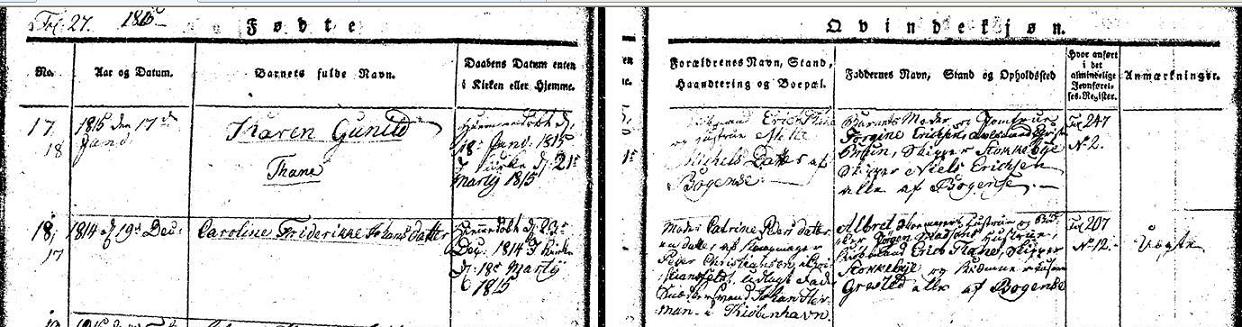
Baptismal Record of Caroline Friderikke Johansdatter, born December 19, 1814.
Of interest is the Danish word "udlagt" which means 'presented' or 'alleged' (fifth column, fourth row in Caroline's entry).
This word implies that the child was illegitimate.
The fifth and sixth rows list "Johan Herman" from "København" (Copenhagen) as the father.
Source: Borgense Kirkebog, 1813-1823, s 26.
Thanks to Allan Larsen and Kirsten E. Williams, great great great granddaughter of Caroline Johansdatter,
for the document and information.
In 1948 one of Caroline's great granddaughters, Eli Bertelsen, wrote a partial genealogy connecting Eli directly to Johan Herman Mankell and Catrine Pedersdatter Grønkiær. The document lists the relationship between Johan Herman Mankell and Catrine Pedersdatter Grønkiær and notes the illegitamate daughter from this relationship. In 1841 Caroline Johansdatter married Carl Christian Hansen. Caroline died on June 9, 1894 in Copenhagen. Caroline and her husband had children, grandchildren and subsequent generations of descendants.
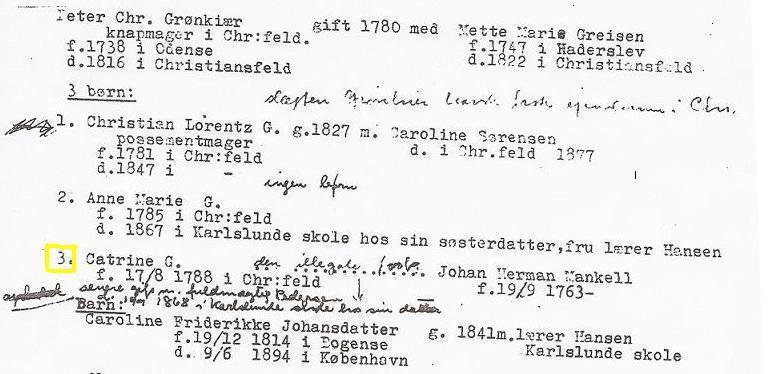
A portion of Eli Bertelsen's ancestor chart, written in 1948, listing 3 generations:
Caroline Johansdatter; her father Johan Herman Mankell and mother Catrine Pedersdatter Grønkiær (marked in yellow)
with two siblings of Catrine; and parents of Catrine--Peter and Mette Grønkiær.
Thanks to Allan Larsen for this document.
By 1816 Johan Herman Mankell was in Sweden where he would marry again, father more children, and live until his death in 1835.
Bibliography: Reventlow; Grell; Hunter, p. xi-xiii, Vogt;