Mankell Family History
Julius Mankell (1828-1897)
Julius Mankell's
Wikipedia entry
Born in 1828 in Stockholm, (see maps) Julius was the oldest child of Carl Abraham and Carolina, and is primarily known as a military historian and Swedish politician. He was educated at the school of St. Klarakyrka where his father was organist and the New Elementary School, where CA was a music teacher. His was interested in music and painting, however he wanted to join the military. In 1847 Julius began his military career in various regiments (Svea, Gothenburg, Värmland) moving up from sergeant to sub-lieutenant, to captain, serving until 1874, when King Oscar II became king. Because his radical views led to conflicts with his military superiors, Julius never advanced higher than the rank of captain.
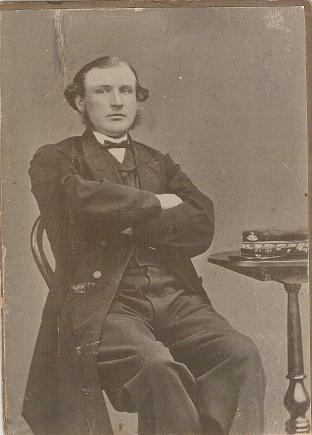
Julius Mankell
During his years in the military he also wrote books and essays about military histories in Europe, including Sweden. His views didn’t always put the Swedish military in the best light. According to a translation of the Svenskt Biografiskt Lexikon Julius wrote a “history of the skärgård (island archipelago east of Stockholm) fleet, and how to best use the fleet in case of a war with Russia. He argued that the skärgård fleet should be divided from the rest of the Navy. The work was published anonymously and generated a lot of discussion.” By 1866 the naval minister carried out his plan, but under the new King Oscar II, the fleet was reunited in 1873.
According to the Svenskt Biografiskt Lexikon, Julius
“wrote articles on the structure of the military, arguing for the arming of the citizenry. He also wrote about Sweden’s fortifications, arguing for the fortification of Stockholm and the centralization of the army there. He gave strategic advice during the Polish uprising of 1863 and the Crimean War. During this war he was captured by the Austrians and held for a few days.”
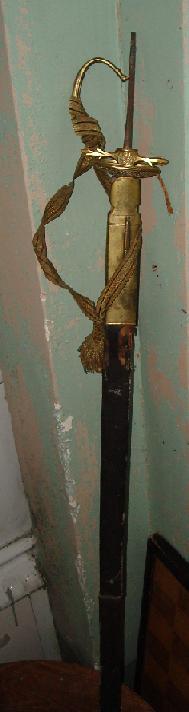
Julius Mankell's sword
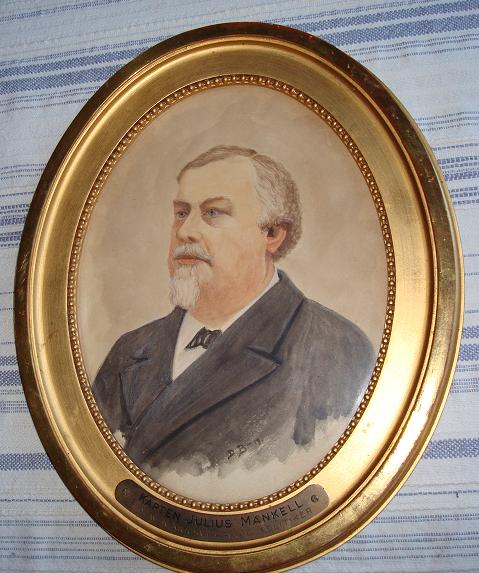
Julius Mankell
Julius wrote several books on military history including an illustrated book about uniforms, and one book about Finnish military history. He contributed to a book on the military history of Sweden, 1500-1814. He wrote a positive essay about King Karl XII and his military leadership. He wrote critical essays about King Gustavus Adolphus who died in battle during the Thirty Year’s War (1618-1648). Because of these essays many people, including King Oscar II, criticized his work.
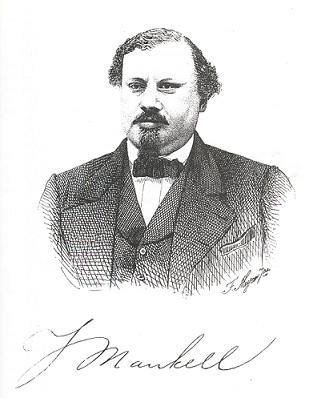
A drawing of Julius Mankell in the December 15, 1866 issue of the Ny Illustrerad Tidning
(New Illustrated Newspaper), located at the Kungliga Biblioteket (Royal Library) in Stockholm.
Thanks to Adam Cwiklak for the drawing and citation.
As to his political activities and views, Julius was active in the workers’ movement and helped develop the New Liberal Society in 1867. Julius was a Stockholm city councilman beginning in 1866, where he tried to put an end to wasteful spending. In 1869 he was elected to the lower house of the Riksdag (Parliament or legislature) where he again attempted to implement his ideas. During the elections of 1869-1871 he supported the Farmers’ Party. He “opposed the reunification of the skärgård fleet with the rest of the Navy, argued for the abolition of property taxes in favor of income tax, fought for the right to vote, and opposed the death penalty.”
Following the elections of 1872, the Swedish political scene moved in a more conservative direction and Julius was not reelected to parliament, though he remained a spokesman for the Farmers’ Party. In 1882 he was elected to the upper house of the Riksdag, but he wasn’t comfortable with their conservative politics, so in 1890 he returned to the lower house. There he “proposed a business program, and was a leader in the fight for voting rights. However, he became isolated within the party.”
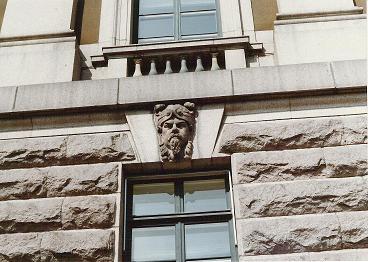
Relief of Julius Mankell on the Parliament Building, Gamle Stan (Old Town) in Stockholm
Swedish historian Victor Lundberg (Swedish Doctor of Philosophy in History) has researched the political life of Julius Mankell. In 2006 Mr. Lundberg gave a presentation (pdf file) at a conference with the theme: "Political Outsiders in Swedish History." Here is the opening paragraph of his essay "Captain Julius Mankell's Vision: Arming the People in Struggle for Democracy":
The aim of this presentation is twofold. On the one hand, I will introduce you to the Swedish army Captain Julius Mankell (1828-1897) and his life and lifework. On the other hand, I will use him to illuminate a rather hidden and/or forgotten radical tradition in the political history of Sweden. Because in a wide context, Captain Mankell is interesting as spokesman for a fallen ideological alternative in the political formation process of modern Sweden.Victor Lundberg continues his research on the life of Julius Mankell and his politics.
Julius Mankell married twice, first to Maria Albertina Coghen from Poland in 1863. She died in 1878. His second wife was Ebba Charlotta Lindvall who he married in 1880. Two children were born to Julius and Ebba. Julia was born in 1881; Julius Abraham was born in 1887. Julia married Gustaf Knochenhauer. Descendants include Bengt Knochenhauer in Stockholm and the Ek family (some live in Copenhagen).
Military historian and politician Julius Mankell died in Stockholm on 23 February 1897. As noted in the Warren Sheaf, (Warren MN) dated January 28, 1897, Julius resigned as President of the Swedish suffrage society only a few weeks prior. He is buried at Stockholm's Norra Begravningsplatsen cemetery in the family plot. This plot also includes his wives Maria and Ebba, his children and members of the Ek and Knockenhauer families. The Willmar Tribune in Kandiyohi County MN (and other newspapers) published a weekly "Scandinavian News" section. Julius death was noted in the March 23, 1897 issue.
Julias [sic] Mankell, for a long series of years the liberal party in Sweden, died in Stockholm at the age of 60 years. "The sacrifices which the warm hearted leader made for a cause of his discouraged people shall never be forgotten, but they will not be properly appreciated until the history of the suffrage movement is written with the pen of the victors. The old, venerable Mankell on account of his sacrifices, was subjected to infinite scorn by his adversaries, but he bore everything manfully and cheerfully, knowing that he was waging a noble war by defending the vital interests of hundreds of thousands of his countrymen, and that he staked the best part of himself in the struggle."Other information in the Willmar Tribune regarding Julius included a notice that "a silver wreath from the liberal society of Norway was placed on the coffin of Captain Mankell of Stockholm". (article dated March 30, 1897). An article in the newspaper (dated August 17, 1897) stated that "a monument on the grave of Julius Mankell, the great liberal leader, was dedicated July 16" .
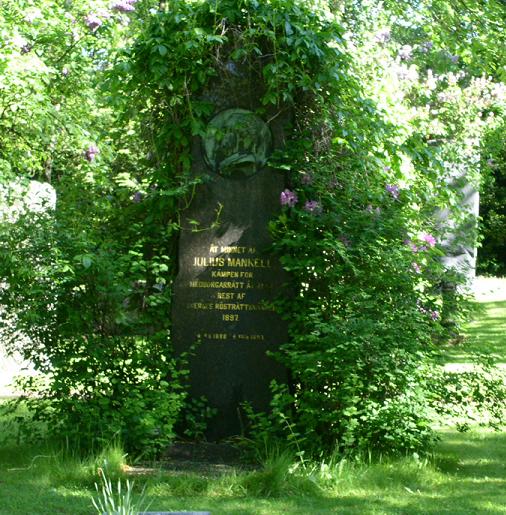
Julius Mankell's grave marker
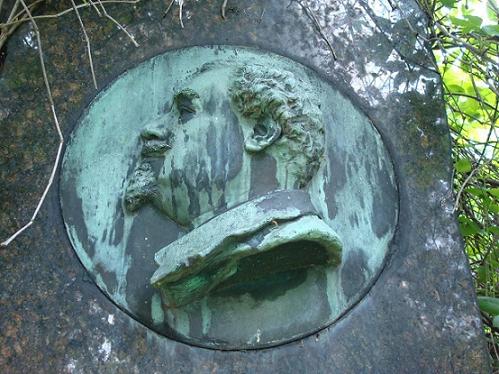
A portion of Julius Mankell's grave marker